

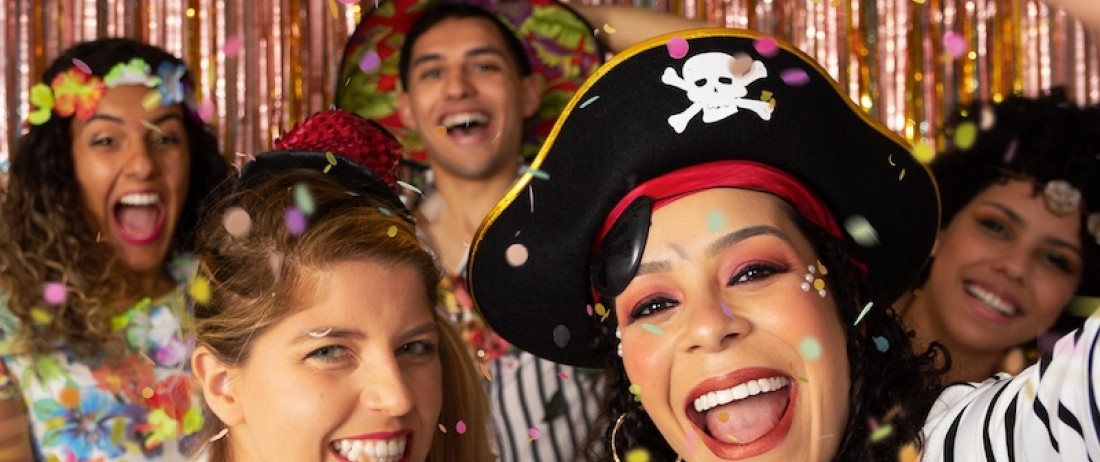
Carnival is a very ancient celebration! Just think: it dates all the way back to the Greek and Roman world, but it became established only later, with the rise of the Catholic religion. In Italy we have many traditional festivals linked to Carnival, and many Italian cities stand out for their celebrations and costumes.
Since ancient times, it has been customary during Carnival to wear bright, colorful masks of every type and shape. This custom, in fact, goes back to ancient times: the mask, which made our ancestors unrecognizable, allowed them to abolish the pre-established order. In this way, everyone became what they wanted to be; there were no longer obligations or social classes.
But enough of that—join us for the festivities! Let’s start talking about language: “Semel in anno licet insanire” is an ancient Latin saying that we could translate as “Once a year, it is allowed to go crazy!”
So why not come here to Dilit during the crazy Carnival season?
Why is it called “Carnival”?
The word “Carnival” comes from the Latin carnem levare, meaning “to remove the meat”, because in the past it referred to the banquet held on the last day of Carnival (Fat Tuesday—we’ll talk about it in a moment…) before the period of abstinence and fasting imposed by Lent, during which no one was allowed to eat meat!
During Carnival, people commonly say “Ogni scherzo vale” (“every joke counts”). This proverb has a strong linguistic value: we are looking at an inclusive rhyme (Carnevale with vale), which is why you can remember it very easily during your stay in Rome. The best part is that, precisely because Carnival is not celebrated on one specific day but lasts for quite a while, you can enjoy the irony and lightness that this time of year offers—especially here at our fantastic Italian language school!
Italian has many forms, and Carnival has many masks
Italian Carnival gives you the chance to learn Italian through masks—and not only standard Italian, but also the regional and dialectal Italian that characterizes the Bel Paese. In fact, here you can find a typical mask for every Italian region.
Be careful: we’re not talking only about masks, but about real human “types,” defined by a specific language, a distinctive way of acting and being, and a costume linked to the traditions and customs of their region of origin. These masks are part of Italy’s enormous cultural heritage because they are the result of the famous Commedia dell’Arte.
The best known is certainly Arlecchino (Harlequin), an agile, work-shy servant—clever and decidedly cheerful. We are in the north, in Lombardy, specifically in Bergamo. Legend has it that Arlecchino was the son of a very poor woman, who had to send her child to school wearing clothes full of holes and patches. So, one day, the other mothers, moved by compassion, decided to sew all the patches together, creating a wonderful multicolored outfit.
In Italian today, a bit of Arlecchino remains in the way we speak. In fact, the expression “Essere un Arlecchino” means behaving in a funny or not very serious way. The character of Arlecchino speaks in a lively language with a strong Lombard inflection.
Arlecchino’s antagonist, also from Bergamo, is Brighella, a grumpy and deceitful type, ready to do anything for his own advantage. Balanzone, typical of Bologna, is an elegant, educated and refined character, but not very good at his job. Pantalone is an old, broke merchant with a difficult temperament.
Colombina is the most famous female mask of all, and she is Pantalone’s daughter—both symbols of Venice. She is a loyal and very intelligent maid, capable of outsmarting her gruff father and his entourage.
Gianduia is the favorite mask of the people of Piedmont. Its name comes from the Piedmontese expression “Gioan d'la douja”, meaning “John of the jug”. Like a good Italian, he certainly isn’t the type to turn down a glass of wine!
And how could we not mention Pulcinella? A symbol of Naples, with a hooked nose and a black mask—clumsy and playful. In theatrical performances, Pulcinella speaks a Neapolitan dialect with popular and ironic tones. In Italian, “fare il Pulcinella” means pretending to be naive. And “il segreto di Pulcinella” means a secret that everyone knows… a fake secret, in other words.
But now let’s get to us! Let’s move to Rome, where Dilit has been living for more than 50 years. In the capital, in February, Carnival awaits you with its typical mask: Rugantino.
“Rugà” in old Roman dialect is a behavior we could define as “arrogant and cheeky”. Rugantino is like that—cheeky but likable. Rugantino uses many expressions typical of Roman dialect that you can hear here in Rome, in the characteristic ancient alleyways, when you come to visit us at Dilit.
Carnival is not only masks! A taste of it
The typical Carnival food is, above all, fried and sweet—abundant and delightful. The traditional Carnival sweets are… Frappe! We call them “frappe” because we’re in Rome, but this delicious specialty has traveled all over Italy and changed its name depending on the city. You may come across “chiacchiere”, “bugie”, or “cenci”. Wherever you go, though, you’ll eat thin, crispy sheets, covered with chocolate or powdered sugar.
But you don’t think it ends here, do you? Castagnole are small balls of fried dough, coated in sugar, possibly filled with custard or ricotta. And then there are also frittelle, pignolata, or migliaccio. And when it comes to savory food, we certainly don’t hold back… Come visit us and you’ll find out!
After all, the Carnival period culminates with the traditional “Fat Thursday”, which, since ancient times, marked the day of the great celebrations and ushered in the most intense part of the festival, with hearty banquets. “Fat Tuesday”, on the other hand, is the last day of Carnival, after which Lent begins (40 days of sobriety and renunciation, according to Christian tradition) with Ash Wednesday.
Fat Thursday and Fat Tuesday 2026
This year, Fat Thursday will fall on Thursday, 12 February 2026, while Fat Tuesday will be on 17 February 2026. Ready to celebrate with us at Dilit? We’re waiting for you… Don’t play tricks on us (not absolutely every single one counts, come on!!! ????). The banquet is ready—have you got your costume? We’re waiting for you.


